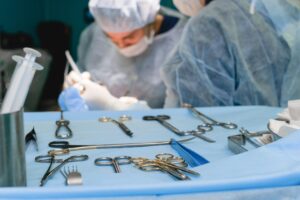
Cadaver surgical training is especially valuable for orthopedic sports physicians and surgeons because many sports-related procedures require a deep understanding of complex three-dimensional anatomy, precise tissue handling, and techniques that can be difficult to master through observation alone.
Some of the key benefits include:
1. Mastering complex anatomy
Sports medicine surgeons operate in areas where small differences matter, such as the:
- Shoulder (rotator cuff, labrum, instability procedures)
- Knee (ACL reconstruction, meniscus repair, cartilage restoration)
- Hip (arthroscopy and labral procedures)
- Ankle and foot (ligament reconstruction, tendon repair)
Cadavers allow surgeons to directly study:
- Ligament attachment sites
- Tendon pathways
- Nerve locations
- Blood supply
- Joint spaces and biomechanics
This helps surgeons better understand the structures they are trying to preserve or repair.
2. Practicing procedures before treating patients
Cadaver labs provide a setting where surgeons can rehearse techniques such as:
- ACL reconstruction
- Shoulder stabilization procedures
- Rotator cuff repair approaches
- Tendon transfers
- Osteotomies (bone realignment procedures)
- Cartilage restoration techniques
This repetition helps refine:
- Instrument handling
- Surgical positioning
- Portal placement in arthroscopy
- Implant placement
- Repair strategies
3. Improving minimally invasive skills
Many sports medicine procedures are performed arthroscopically, using small incisions and a camera. Cadaver training helps surgeons develop:
- Hand-eye coordination
- Camera navigation skills
- Instrument control
- Spatial awareness inside joints
These skills are difficult to fully learn from textbooks or videos.
4. Understanding variations between patients
Human anatomy is not identical from person to person. Cadaver training exposes surgeons to:
- Variations in bone shape
- Differences in tendon size and quality
- Unexpected anatomical relationships
- Degenerative changes or prior injuries
This experience can improve intraoperative decision-making.
5. Learning new technologies and implants
Before new devices or techniques are widely used, surgeons often train on cadaver specimens to evaluate:
- New surgical instruments
- Repair devices
- Joint implants
- Navigation systems
- Patient-specific guides
This allows surgeons to understand the advantages and limitations of new technology before applying it clinically.
6. Enhancing surgical precision and safety
Sports medicine often involves working near critical structures, such as:
- Nerves around the shoulder and elbow
- Major blood vessels
- Articular cartilage surfaces
- Growth plates in younger athletes
Cadaver practice helps surgeons understand safe approaches and avoid preventable complications.
7. Team training and communication
Modern orthopedic care is team-based. Cadaver labs allow:
- Surgeons
- Fellows
- Residents
- Physician assistants
- Surgical staff
to practice workflows, positioning, instrumentation, and communication around complex procedures.
8. Advancing athlete care
The ultimate goal is improved outcomes for athletes, including:
- Faster and safer return to sport
- Better restoration of joint function
- Lower complication rates
- More durable repairs
A surgeon who has practiced a technique repeatedly in a realistic anatomical environment is better prepared to perform it effectively when caring for an injured athlete.
9. Combining cadavers with modern technology
Today’s highest-level orthopedic training often combines cadaver work with:
- 3D-printed anatomy models
- Virtual reality simulation
- Surgical navigation
- Artificial intelligence–assisted planning
- Motion analysis and biomechanics labs
Together, these tools provide a more complete training experience.
In sports medicine, where surgeons are often restoring high-performance joints in demanding patients, cadaver training remains one of the most effective ways to bridge the gap between learning a procedure and safely performing it in the operating room.