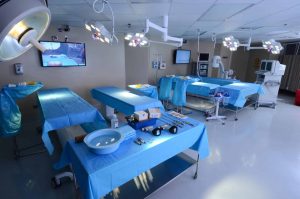
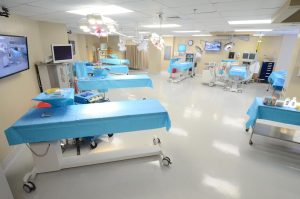
Cadaver training plays a major role in translating recent robotic-surgery advances from the lab into safe clinical practice. As robotic systems become more complex — especially with AI assistance, augmented reality, haptic feedback, and new robotic platforms — surgeons need realistic environments to train, validate techniques, and study human anatomy under true surgical conditions.
Here are the main ways cadaver training supports these advances:
Training surgeons on new robotic platforms
With many newer robotic systems entering the market, such as Intuitive Surgical’s da Vinci competitors and regional platforms from Europe and Asia, cadaver labs allow surgeons to:
- learn console controls,
- practice docking and instrument placement,
- compare ergonomics,
- and adapt to different workflows safely before operating on patients.
Cadavers provide realistic tissue planes, anatomical variability, and procedural complexity that synthetic models often cannot fully reproduce.
Developing AI-assisted surgery systems
AI-guided robotic systems need enormous amounts of high-quality surgical data.
Cadaver training contributes by enabling:
- recording of expert robotic procedures,
- annotation of anatomical landmarks,
- collection of force and motion data,
- and testing of autonomous subtasks like suturing or dissection.
This helps train machine-learning models that can later assist surgeons in real operations.
For example, semi-autonomous robotic functions can be validated repeatedly on cadaver specimens before moving into animal or human trials.
Testing haptic feedback systems
New robotic systems increasingly include force sensing and tactile feedback.
Cadaver labs help engineers and surgeons:
- calibrate pressure thresholds,
- evaluate tissue handling,
- compare tactile realism,
- and refine force-feedback algorithms.
Because cadaver tissue behaves more realistically than many simulators, it gives developers better information about how robotic instruments interact with:
- nerves,
- blood vessels,
- fascia,
- bone,
- and delicate organs.
Improving minimally invasive and single-port techniques
Many modern robotic systems aim to reduce incision size and surgical trauma.
Cadaver training allows surgeons to:
- practice difficult access angles,
- optimize trocar placement,
- rehearse confined-space maneuvers,
- and study internal visualization limitations.
This is especially important for:
- transoral robotic surgery,
- pelvic surgery,
- neurosurgery,
- and single-port robotic procedures.
Supporting augmented reality and image-guided surgery
AR-assisted robotic surgery relies heavily on accurate anatomical mapping.
Cadaver labs are used to:
- correlate imaging scans with actual anatomy,
- test navigation overlays,
- validate tumor localization,
- and improve real-time registration systems.
Researchers can compare CT/MRI-based guidance directly against physical anatomy to improve accuracy.
Validating robotic spine and orthopedic systems
Robotic orthopedic and spine platforms require extremely precise alignment.
Cadaver-based testing helps verify:
- screw placement accuracy,
- implant trajectories,
- robotic navigation precision,
- and collision avoidance.
Because bone density and anatomical variation differ significantly between individuals, cadavers provide valuable real-world variability for testing.
Enabling procedural innovation
Surgeons often develop entirely new robotic procedures in cadaver labs before attempting them clinically.
Cadaver sessions allow teams to:
- refine step-by-step workflows,
- identify instrument limitations,
- determine safe anatomical corridors,
- and anticipate complications.
Many new robotic colorectal, thoracic, and urologic procedures were first refined this way.
Improving emergency response and rare-case preparation
Cadaver training is also useful for:
- uncommon anatomy,
- trauma scenarios,
- revision surgery,
- and complex complications.
This becomes even more important as robotic surgery expands into higher-risk and more technically demanding procedures.
Human factors and team training
Modern robotic surgery involves coordination among:
- surgeons,
- anesthesiologists,
- bedside assistants,
- nurses,
- and engineers.
Cadaver labs allow entire surgical teams to rehearse:
- communication,
- OR setup,
- troubleshooting,
- emergency conversion to open surgery,
- and equipment failures.
This systems-level training is difficult to reproduce in simulation alone.
Ethical and safety advantages
Cadaver training creates a safer bridge between:
- computer simulation,
- animal testing,
- and live human surgery.
It allows repeated experimentation without patient risk, which is particularly important for:
- new AI-assisted features,
- autonomous robotic functions,
- and experimental instrumentation.
Emerging trend: “smart cadaver labs”
Some advanced training centers now combine cadavers with:
- motion tracking,
- AI analytics,
- VR overlays,
- digital twins,
- and robotic telemetry systems.
This creates hybrid training environments where surgeons can receive quantitative feedback on:
- precision,
- efficiency,
- instrument pathing,
- and tissue handling.
Overall, cadaver training remains one of the most important transitional steps between robotic-surgery innovation and safe real-world adoption.