Robotic surgery has advanced rapidly in the last few years, especially through the integration of AI, improved sensing, remote operation, and new robotic platforms. Here are some of the most important recent developments:
AI-assisted and semi-autonomous surgery
One of the biggest shifts is the move from robots being purely surgeon-controlled tools toward systems that can assist with parts of procedures autonomously.
Researchers at Johns Hopkins University demonstrated an AI-guided robotic system that successfully performed autonomous gallbladder removal on pig organs with a 100% success rate in controlled experiments. The robot adapted in real time to anatomical variation and corrected its own mistakes during surgery.
These systems use machine learning models trained on surgical videos and sensor data to:
- identify tissue structures,
- predict surgical intent,
- assist with suturing and cutting,
- detect potential failures early,
- and hand control back to humans when uncertainty becomes too high.
Most experts still see fully autonomous surgery as years away, but “shared autonomy” is becoming realistic for repetitive surgical subtasks.
Haptic feedback (“sense of touch”)
Traditional robotic systems largely rely on visual feedback. Surgeons often cannot physically feel tissue resistance, which has been a major limitation.
New systems now incorporate force sensing and tactile feedback. For example, the Intuitive Surgical da Vinci 5 platform introduced integrated force-feedback technology, allowing surgeons to feel pressure during procedures.
Recent research also includes:
- wearable wrist-based haptic systems,
- tactile palpation sensors,
- audio-enhanced force cues,
- and AI-assisted tactile interpretation.
This improves:
- precision,
- tissue handling,
- training quality,
- and potentially patient safety.
Telesurgery and remote operation
Telesurgery — operating remotely through robotic systems — is becoming more practical because of:
- lower-latency communication,
- improved robotics,
- augmented reality overlays,
- and AI-assisted stabilization.
Modern systems can now support:
- remote expert consultation during surgery,
- surgical mentoring across continents,
- and potentially emergency surgery in underserved areas.
Some experimental platforms even use humanoid robots to operate standard laparoscopic instruments remotely, reducing the need for specialized operating-room infrastructure.
Augmented reality and surgical visualization
AR overlays are increasingly being integrated into robotic surgery systems.
These technologies can:
- project anatomical maps onto the surgical field,
- highlight tumors or blood vessels,
- guide incision placement,
- and support intraoperative navigation.
Combined with AI image analysis, surgeons can receive real-time guidance during minimally invasive procedures.
New robotic platforms beyond da Vinci
For years, the market was dominated by the Intuitive Surgical da Vinci system. Recently, many competing platforms have emerged globally.
Examples include:
- Hugo RAS,
- Versius,
- Senhance,
- Hinotori,
- Dexter,
- Toumai,
- and India’s Mizzo Endo 4000.
These newer systems aim to improve:
- affordability,
- modularity,
- portability,
- ergonomics,
- and access in lower-resource hospitals.
Specialized robotic systems
Robotic surgery is becoming increasingly specialized rather than “one robot for everything.”
Recent systems target:
- spine surgery,
- orthopedic navigation,
- endoscopy,
- microsurgery,
- and single-port minimally invasive surgery.
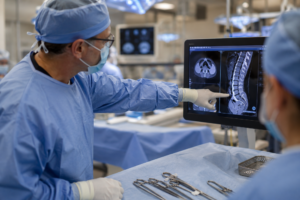
Some spine systems now combine:
- robotic arms,
- real-time imaging,
- navigation software,
- and AI-based trajectory planning.
Better training and simulation
Modern robotic surgery training increasingly uses:
- VR simulators,
- AI performance analysis,
- force-feedback simulators,
- and digital twins of patient anatomy.
These tools help surgeons:
- practice difficult procedures safely,
- receive automated skill assessment,
- and shorten learning curves.
Current limitations
Despite the progress, robotic surgery still faces important challenges:
- very high equipment costs,
- long training times,
- limited tactile realism,
- regulatory hurdles,
- and concerns around AI reliability and accountability.
Most systems today remain “robot-assisted” rather than fully autonomous. Human surgeons still make the critical decisions.
Where the field is heading
The next decade will likely focus on:
- greater AI assistance,
- safer semi-autonomous procedures,
- improved tactile sensing,
- more affordable robotic systems,
- cloud-connected operating rooms,
- and wider use in community hospitals rather than only elite medical centers