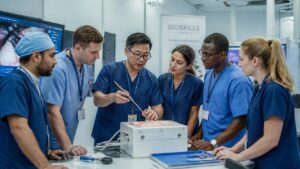
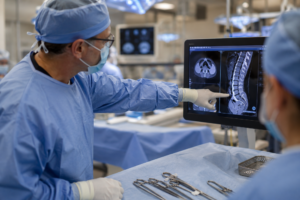
Hands-on surgical training using human cadaver specimens, they can be a very valuable supplement to a resident surgeon’s clinical training. The main advantage is that they allow residents to practice realistic anatomy, operative exposures, and surgical techniques in a controlled environment before performing them on patients.
How cadaver courses help resident surgeons
- Strengthen three-dimensional anatomy knowledge. Residents can see the actual relationships among muscles, fascia, nerves, vessels, and organs rather than relying only on 2-D images or textbooks. This is particularly valuable for complex or anatomically variable procedures.
- Bridge the gap between anatomy and the operating room. Cadaver courses translate anatomical knowledge into practical surgical decision-making—where to make an incision, which structures to identify, how to obtain an exposure, and what structures need to be protected. Studies have specifically described cadaver courses as helping bridge the gap between gross anatomy and operative practice.
- Develop technical and tissue-handling skills. Residents can practice dissection, instrument handling, surgical planes, retraction, exposure, suturing, and procedural steps using human tissue. A study of a cadaveric procedural anatomy course found improvements in procedure-specific performance, instrument handling, tissue respect, time and motion, operative flow, and procedural knowledge.
- Build operative confidence. Residents can repeat difficult steps and make mistakes without putting a patient at risk. In a five-year cadaver-based curriculum, residents reported sustained improvements in anatomy knowledge, technical dissection skills, exposure to procedures they might not otherwise encounter, and confidence performing operative skills independently.
- Increase exposure to less-common procedures. Clinical rotations don’t guarantee that every resident will encounter every important operation. Cadaver laboratories can deliberately expose residents to procedures or anatomical approaches that they may have limited opportunity to perform during residency.
- Prepare residents for complex cases. A cadaver provides high anatomical fidelity and allows residents to work through an operation from exposure to completion. This is especially useful for procedures where anatomy and tissue relationships are difficult to reproduce with synthetic models.
- Provide structured faculty feedback. When an experienced surgeon guides the dissection, residents can receive immediate feedback on anatomy, instrument positioning, surgical planes, technical errors, and operative strategy.
The developmental benefit
The broader value is that cadaver training can help move a resident through a progression:
Anatomical knowledge → procedural understanding → hands-on technical skill → confidence → supervised clinical application → greater operative independence.
For example, a resident might first learn the anatomy of a particular surgical approach, then perform the exposure on a cadaver, identify the relevant nerves and vessels, practice the operative sequence, receive faculty feedback, and subsequently be better prepared when encountering that operation in the OR.
There is evidence supporting this educational progression. One study found that anatomy examination scores increased from 50.5% to 83.5% after implementation of a cadaver dissection curriculum, while residents also reported improvements in technical skills.
An important limitation
Cadaver courses should complement—not replace—clinical operative experience. Cadavers cannot reproduce bleeding, living tissue perfusion, anesthesia, patient-specific pathology, physiologic responses, or the interpersonal and team aspects of an actual operation. Moreover, a systematic review of 51 cadaveric-training studies found evidence for short-term skill acquisition but noted that evidence for long-term skill retention and transfer to the live operating room remains limited.
So, the strongest role for a Bio Skills cadaver course is as a high-fidelity bridge between learning an operation intellectually and performing it safely under supervision on a living patient. It can accelerate the acquisition of anatomy, technical skills, spatial awareness, and operative confidence while providing residents with a safe environment in which to learn from mistakes.