Medical education has evolved far beyond textbooks, lectures, and basic anatomy labs. Today’s healthcare professionals need realistic, hands-on training that prepares them for the complexity of real patient care. One of the most advanced tools available for procedural and surgical education is the perfused cadaver. These innovative training models are commonly used in bioskills labs and cadaver labs, where healthcare professionals can practice procedures in a realistic, hands-on environment.
Unlike traditional cadavers used primarily for anatomy instruction, perfused cadavers simulate blood flow, allowing physicians, surgeons, military medics, and other healthcare professionals to practice life-saving procedures under conditions that closely resemble treating a living patient.
So, what is a perfused cadaver, and why has it become such an important part of modern medical training?
What Is a Perfused Cadaver?
A perfused cadaver is a donated human body that has been specially prepared so a blood-like fluid can circulate through its vascular system. Using pumps and specialized equipment, the circulatory system is pressurized to mimic blood flow during medical procedures.
This realistic simulation allows trainees to experience challenges they would encounter in the operating room or emergency department, including active bleeding, vascular access, and tissue handling.
Because the anatomy is real and the tissues behave much more naturally than synthetic models, perfused cadavers offer one of the closest training experiences to working on a living patient.
How Does a Perfused Cadaver Work?
After a donor has been appropriately prepared for medical education, the body’s blood vessels are connected to an external perfusion system. This system circulates a specially formulated fluid throughout the arteries and veins.
Depending on the type of training being conducted, the system can simulate:
- Blood flow through major vessels
- Controlled bleeding during surgical procedures
- Varying vascular pressures
- Hemorrhage requiring rapid intervention
Some advanced training laboratories also incorporate ventilation systems that simulate breathing, creating an even more lifelike environment for airway management and thoracic procedures.
The goal is not to perfectly recreate every aspect of human physiology but to provide a highly realistic procedural experience that bridges the gap between simulation and live patient care.
How Are Perfused Cadavers Prepared?
Preparing a perfused cadaver requires specialized expertise and careful attention to preserving anatomical structures. While the exact process varies among training facilities, the general steps include:
- Careful screening and acceptance through an anatomical donation program.
- Preservation using techniques that maintain realistic tissue quality, often through fresh frozen preservation.
- Cannulation of major blood vessels so they can be connected to a perfusion system.
- Testing the vascular network to ensure fluid can circulate throughout the body.
- Setup of pumps and reservoirs that simulate circulation during training exercises.
Every preparation is performed with respect for the donor and in accordance with ethical and legal standards. Donors make an extraordinary contribution to advancing healthcare by helping train the next generation of medical professionals.
Why Are Perfused Cadavers Used?
Many medical procedures require more than simply knowing where anatomical structures are located. Healthcare professionals must also learn how tissues respond, how blood vessels behave, and how to manage complications that occur during treatment.
Perfused cadavers provide an opportunity to develop these skills in a controlled educational environment.
They are commonly used for:
- Trauma surgery
- Emergency medicine
- Combat casualty care
- Orthopedic surgery
- Vascular surgery
- Neurosurgery
- Cardiothoracic procedures
- Airway management
- Hemorrhage control
- Emergency medical services (EMS) training
Because trainees can practice repeatedly without risking patient safety, perfused cadavers have become an essential resource for improving procedural competence and confidence.
Common Procedures Practiced on Perfused Cadavers
Perfused cadavers support a wide variety of advanced procedural training. Healthcare professionals can practice techniques that require both precise anatomy and realistic tissue response.
Examples include:
- Surgical incisions and wound closure
- Vascular repair
- Chest tube placement
- Emergency thoracotomy
- Airway management and intubation
- Cricothyrotomy
- Central venous catheter placement
- Ultrasound-guided procedures
- Hemorrhage control
- Orthopedic fixation techniques
Medical device manufacturers frequently partner with bioskills labs to evaluate implants, surgical instruments, and emerging technologies before clinical use. Because perfused cadavers provide realistic anatomy and simulated blood flow, they offer an ideal environment for product development, physician education, and procedural validation.
Benefits of Perfused Cadaver Training
Medical simulation has advanced significantly over the past several decades, but even sophisticated mannequins have limitations. Perfused cadavers provide advantages that many other training methods cannot replicate.
-
Real Human Anatomy
Every person has unique anatomical variations. Working with donated human tissue exposes healthcare professionals to the natural differences they will encounter throughout their careers.
-
Simulated Bleeding
One of the biggest advantages of a perfused cadaver is the ability to simulate bleeding. This allows physicians and emergency responders to practice controlling hemorrhage under realistic conditions.
-
Improved Surgical Skills
Surgeons can refine techniques, evaluate new approaches, and become familiar with specialized instruments before performing procedures on living patients.
-
Better Team Training
Perfused cadaver labs allow entire healthcare teams to train together. Surgeons, anesthesiologists, nurses, medics, and technicians can rehearse complex procedures while improving communication and coordination.
-
Increased Confidence
Repeated practice in a realistic environment helps reduce anxiety and improve decision-making when providers encounter similar situations in clinical practice.
Perfused Cadavers vs. Traditional Cadavers
Although both are valuable educational tools, perfused cadavers serve a different purpose than traditional cadavers.
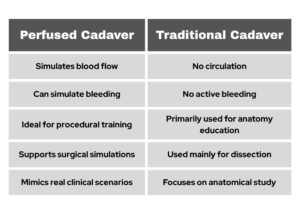
Traditional cadavers remain an essential part of anatomy education, while perfused cadavers expand learning into procedural and surgical skill development.
Perfused Cadavers vs. Simulation Mannequins
High-fidelity mannequins have become increasingly sophisticated, but they still cannot fully replicate human anatomy. Synthetic models are excellent for practicing basic clinical skills, CPR, and emergency scenarios, but they have limitations when teaching complex surgical procedures.
Perfused cadavers provide:
- Real tissue texture
- Natural anatomical variation
- Authentic surgical landmarks
- Realistic instrument handling
- Simulated vascular response
Many training programs combine simulation mannequins and perfused cadavers to provide a comprehensive educational experience.
Are Perfused Cadavers the Same as Fresh Frozen Cadavers?
Not necessarily.
A fresh frozen cadaver refers to the preservation method. Rather than being embalmed with chemicals, the donor is frozen to preserve natural tissue characteristics.
A perfused cadaver refers to the training system that circulates fluid through the vascular network.
Some perfused cadaver programs use fresh frozen donors because they maintain tissue flexibility and realism. Others may use different preservation techniques depending on the educational goals.
In many advanced bioskills labs, a cadaver may be both fresh frozen and perfused, offering an exceptionally realistic surgical training experience.
Who Uses Perfused Cadavers?
Perfused cadaver training benefits a wide range of medical professionals, including:
- Physicians
- Surgeons
- Emergency physicians
- Military combat medics
- Paramedics
- Physician assistants
- Nurse practitioners
- Surgical residents
- Medical students
- Medical device companies developing new technologies
Medical device manufacturers frequently rely on perfused cadavers to test implants, surgical tools, and procedural innovations before they reach operating rooms. This allows engineers and physicians to evaluate device performance using real human anatomy while helping improve safety and effectiveness.
Frequently Asked Questions About Perfused Cadavers
Are perfused cadavers embalmed?
Some are, but many advanced perfused cadaver programs use fresh frozen donors because this preservation method better maintains natural tissue flexibility and surgical realism.
How long can a perfused cadaver be used?
The usable lifespan depends on the preservation method, the type of procedures being performed, and the training objectives. Many are prepared for specific educational events or multi-day training courses.
Are perfused cadavers ethical?
Yes. Perfused cadaver training relies on individuals who voluntarily donate their bodies to science. Medical training organizations follow strict ethical guidelines, legal requirements, and donor consent procedures while treating every donor with dignity and respect.
Why not just use virtual reality?
Virtual reality and computer simulation continue to improve, but they cannot fully replicate the feel of human tissue, anatomical variation, or the tactile feedback clinicians experience during procedures. Perfused cadavers provide a level of realism that remains unmatched for many advanced surgical and trauma applications.
The Future of Medical Training
As medicine continues to advance, healthcare professionals need increasingly realistic educational experiences. Perfused cadavers represent one of the most effective ways to safely practice complex procedures before performing them on patients.
By combining authentic human anatomy with simulated blood flow, these advanced training models help clinicians build technical skills, improve confidence, and prepare for the unpredictable situations they will face in real-world practice.
Whether used in a university anatomy program, a hospital cadaver lab, or a state-of-the-art bioskills lab, perfused cadavers continue to transform medical education. They’re used to train surgeons, emergency physicians, military medics, trauma teams, or evaluating innovative medical devices, perfused cadavers continue to play a vital role in advancing healthcare education. As simulation technology evolves, they will remain one of the most valuable resources for improving procedural competency, supporting medical innovation, and ultimately enhancing patient care.