Cadaver skills training is a cornerstone of preparation in plastic surgery—and not just for beginners. It plays a critical role in building the kind of precision, judgment, and anatomical understanding that real patients depend on. Here are the key reasons it’s so important:
1. True-to-life anatomy (beyond textbooks)
Studying cadavers allows surgeons to see and feel real human anatomy in three dimensions. Unlike diagrams or simulations, cadavers reveal:
- Natural variation between individuals
- Subtle tissue planes and fascial layers
- Exact relationships between nerves, vessels, and structures
This is especially crucial in plastic surgery, where millimeters matter.
2. Safe environment to practice techniques
Cadaver labs provide a zero-risk setting where surgeons can:
- Practice incisions, dissections, and closures
- Refine delicate maneuvers (e.g., flap elevation, graft placement)
- Learn from mistakes without harming a patient
This kind of repetition builds confidence before entering the operating room.
3. Development of tactile skills
Plastic surgery relies heavily on touch—how tissue feels, how much tension is appropriate, and how structures respond. Cadavers help develop:
- Tissue handling skills
- Instrument control
- Force judgment
Even advanced simulation tools can’t fully replicate this tactile feedback.
4. Understanding surgical planes and dissection strategies
Knowing where and how to dissect is fundamental. Cadaver training helps surgeons:
- Identify safe dissection planes
- Avoid critical structures (like nerves and blood vessels)
- Practice efficient, atraumatic techniques
This directly translates to reduced complications in live surgery.
5. Exposure to anatomical variation
No two patients are exactly the same. Cadavers expose trainees to:
- Variations in vascular patterns
- Differences in muscle and nerve anatomy
- Unexpected structural relationships
Recognizing these differences ahead of time improves intraoperative decision-making.
6. Rehearsal of complex or new procedures
For advanced surgeons, cadaver labs are often used to:
- Learn new techniques before performing them clinically
- Rehearse challenging cases
- Test modifications to existing procedures
This lowers the learning curve and improves patient safety.
7. Improved complication avoidance
By practicing on cadavers, surgeons become better at:
- Identifying danger zones
- Preventing nerve injury or vascular compromise
- Anticipating technical pitfalls
This translates into fewer errors and better outcomes.
8. Bridging the gap between theory and live surgery
Cadaver training connects:
- Classroom knowledge
- Simulation practice
- Real operative experience
It’s the critical “middle step” that prepares surgeons for actual patients.
9. Team training and procedural flow
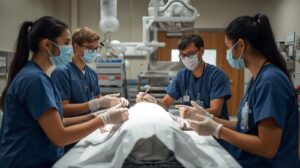
Cadaver labs can simulate full procedures, allowing teams to practice:
- Surgical sequencing
- Instrument coordination
- Communication in the OR
This improves efficiency and reduces intraoperative stress.
10. Ethical responsibility to patients
Ultimately, cadaver training reflects a commitment to patient safety. It ensures surgeons:
- Don’t perform a procedure for the first time on a live patient
- Enter surgery with prior hands-on experience
- Uphold high standards of care
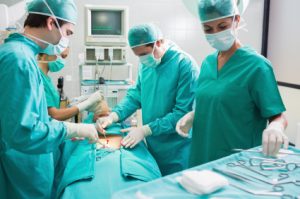
Nurse holding surgical tool next to operating table in an operating theatre